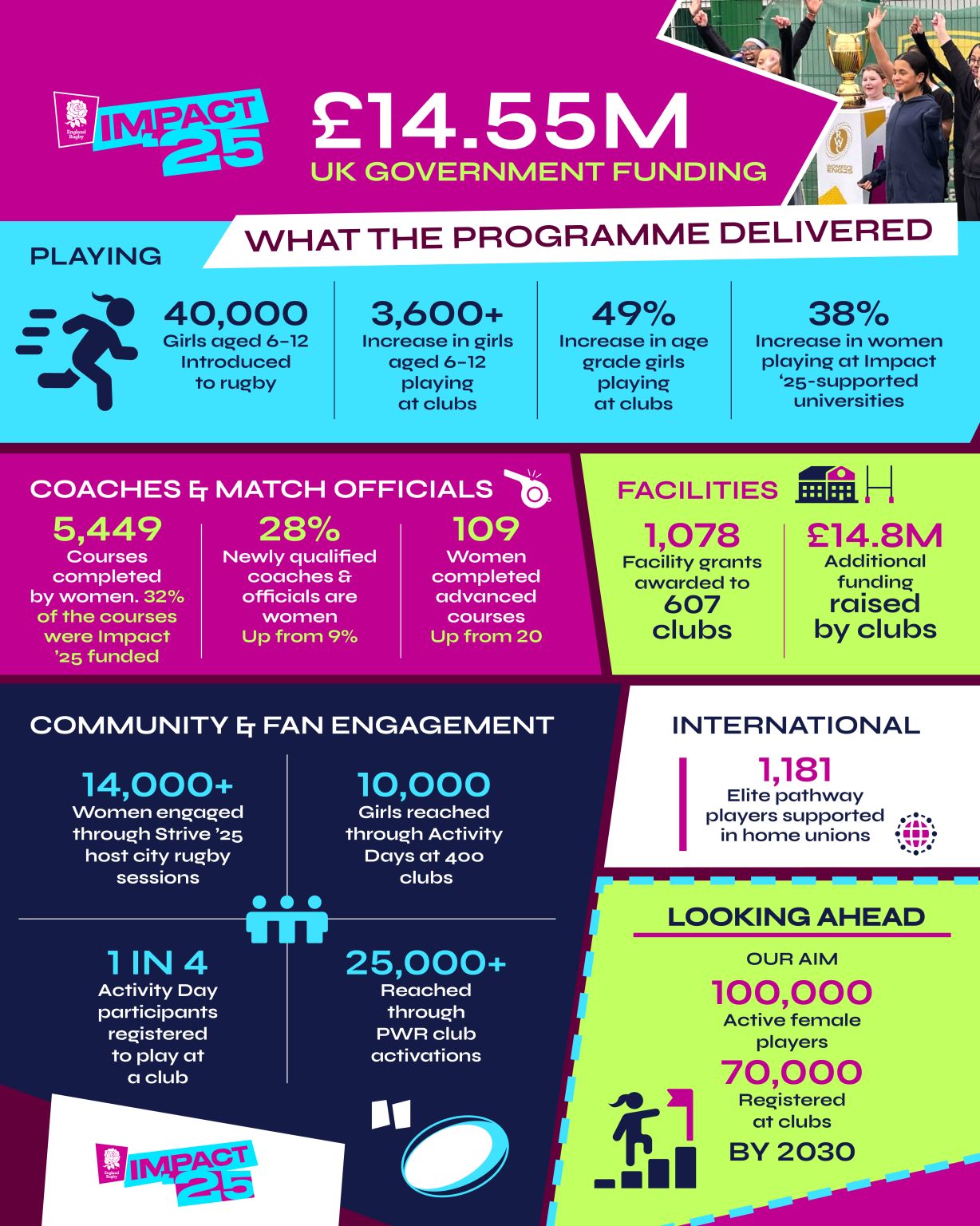
The final report for Impact ’25, the RFU’s Women’s Rugby World Cup 2025 legacy programme, has been released to funders and a short executive summary published publicly, marking the close of TSC’s four-year evaluation. The report, From Kick-Off to Full Time, brings together four seasons of evidence from the Impact ’25 programme across the women’s and girls’ game. It is the last of five reports in which TSC has measured the impact season by season.
What is Impact ’25?
Impact ’25 was the RFU’s domestic legacy programme for the Women’s Rugby World Cup 2025. It was delivered in partnership with the UK Government, Sport England and UK Sport, with the goal of making rugby more accessible to women and girls in England. Over four seasons from 2022/23, £14.55m of Government investment went into five strands: facilities, coaching and officiating, playing and volunteering, community and fan engagement, and the international pathway.
Impact ’25 key statistics
- Girls’ age-grade club registrations grew 49%, from 18,000 to around 26,800.
- Around 40,000 girls aged 6-12 were introduced to rugby
- Women’s participation at supported universities grew by 38%
- 1,078 facility grants went to 607 clubs, and the clubs added £14.8m of their own funding.
- Women now make up 28% of newly qualified coaches and match officials, up from 9% before the programme.
- 78% of funding was spent outside London and the South-East.
A home World Cup
In the final year of Impact ’25, England hosted the Women’s Rugby World Cup 2025. The tournament broke every attendance record in the women’s game, culminating in a world-record crowd of 81,885 at Allianz Stadium and the Red Roses lifting the trophy.
The programme aimed to capitalise on the heightened interest in women’s rugby during the World Cup year. Strive ’25 sessions reached more than 14,000 women and girls across the eight host cities. After the final, the trophy spent 56 days travelling the country, visiting 98 venues and reaching 14,546 people.
Beyond the tournament
Following Impact ’25 across every season meant we could look beyond what was delivered. We could see why it mattered, how the programme changed along the way and where it made the biggest difference. Facilities funding moved from many small grants to fewer, larger projects, and community engagement grew from almost nothing in Year 1 to one of the programme’s biggest drivers.
Growth in girls’ registrations was strongest where support was concentrated. At the 115 focus clubs, which received support from several strands at once, registrations grew 61%, compared to 39% at other clubs. Facilities grants also acted as a catalyst, with clubs raising more than £2 of their own for every £1 awarded. As more girls take up the game, the share of women among newly qualified coaches and match officials has more than tripled, meaning clubs and the wider community game have more skilled personnel to support growth.
Looking back on four years
Impact ’25 leaves women’s and girls’ rugby in England on a stronger foundation than when it began. More girls are registered and playing. The coaching and officiating workforce looks more like the players it serves. Much of the investment, particularly in facilities, should keep paying back long after the grants have been spent.
Over four years, TSC has worked with the RFU to track the programme’s outcomes and build a clear picture of its impact. It has been a pleasure to be part of Impact ’25 from first season to last.
We are grateful to the RFU, and to the clubs, volunteers, coaches, match officials and players whose time and commitment have been central to the programme’s success.
Read the public report here: https://rfu.widen.net/s/98f7gxdw6n/impact-25-final-report–exec-summary